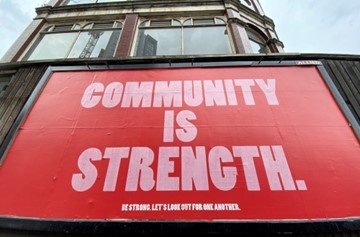
Community Schools Update: Now, Every School Can be a Community School

By Zach Vander Veen
Part One: The Idea
I heard this said in a meeting, by a very smart colleague, “Now, every school can be a Community School.” I had never thought of that before, much less spoken it aloud in a crowded room. I suppose, technically, any school could be a Community School. But would they want to be? And what would be the benefit to the kids, which is the only measure that really matters?
The Community School model is not a new idea; it has been floating around in the ethos for some 30 years now, and several states including California are making great inroads in transforming many of their schools into Community Schools.
The National Center for Community Schools says, “Community Schools are a long-term strategy for student success. They are a partnership of community members and leaders working together to ensure children are surrounded with support. Community Schools are a partnership of community members and leaders working together with student success as the goal.”
In the Community Schools Playbook, a project of the Partnership for the Future of Learning, the organization contends, “Community schools are public schools that partner with families and community organizations to provide well-rounded educational opportunities and supports for students’ school success. Like every good school, community schools must be built on a foundation of powerful teaching that includes challenging academic content supporting students’ mastery of 21st century skills and competencies.
Considerations for Sustainable Community Schools
A Community School is both a place and a set of partnerships between a school and other community resources. It should serve as both an educational institution and a center of community life formed with the intention of meeting students’ social, emotional, educational, and basic needs.
Research confirms that students thrive in educational environments that support not only their learning, but also their emotional, physical and social needs and well-being, all while providing a sense of community.
According to a longitudinal study on the Promise Academy Charter Middle School, Community School students were significantly more likely to graduate high school on time than those in traditional schools. 71 percent of these Community School attendees graduated on time, as compared to 58 percent in traditional schools. The Community School students also scored significantly higher on state exams in math, English, and social studies, gaining 1 to 2 years of grade level advantage over traditional school students.
In a policy brief, Hayin Kimner wrote the following policy analysis for California Education, Stanford University. “Across California, the protracted disruptions to education because of COVID-19 have forced schools and communities to confront the inextricably basic link between health and education.
“Community School strategies have emerged as a promising approach to mitigate the social and learning impacts of COVID-19. Advocates describe Community Schools as a strategy to organize the resources of a community to address and eliminate barriers to learning: a place-based strategy in which schools partner with community agencies and allocate resources to provide an integrated focus on academics, health and social services, youth and community development, and community engagement.”
Kimner says that Community Schools are often seen as providing additional, nonacademic services to students most in need. Counselors, social workers, school nurses, and food banks are part of a support system designed to provide learners with whatever they need to succeed.
Community Schools work best when a collaborative spirit is pervasive, and all the community assets work together. In essence, Kimner illustrates how to connect the dots and writes, “To build and strengthen integrated student and teacher supports, schools and districts can:
- Integrate collective, individual student, and educator wellness check-ins to understand well-being as a regular part of distance and in-person learning, with an awareness of basic needs, feelings of anxiety and fear, stress, isolation, depression, and disengagement, as well as insufficient access to social-emotional support and mental health resources.
- Establish partnerships with mental health resources and providers to support teachers and students experiencing anxiety and stress with strategies and tools that support effective Tier 1 practices around individual and community care.
- Ensure there is a clear system for accessing student and teacher support that is collaboratively designed and implemented by students, teachers, families, and community partners.
- Create a robust and proactive school-based referral and professional learning/coaching system led by interdisciplinary school-based response teams, including experienced classroom teachers (general and special education), administrators, student support specialists, and family and community partners.
- Consider how distance learning may require more effective allocation of student support staff (e.g., school psychologists and specialists) to meet specific student and school needs across school campuses. Working across schools requires consistent and aligned intervention along with professional learning expectations and practices.”
Over 5000 schools in America are already considered as Community Schools. In an American Federation of Teachers publication, Is My School a Community School? A Checklist for Teachers and School Staff, the publication provides a checklist for key areas of collaboration, including Structure: School-Site Level Community School Strategy, Partners: Academic & Nonacademic, Instruction & Programming, School Culture & Climate, Family Engagement and Health and Wellness. “This checklist outlines the essential components of a community school,” says the AFT. “It is important to note that not all Community Schools will have all these elements from the beginning. Building a Community School is a process that requires patience, trust and collaborative partnerships among teachers, school staff, students, families, community partners, and administrators. If your school isn’t a community school yet, this inventory will help you identify areas you need to develop.”
According to the Community Schools Playbook, “Community Schools are effective when they are comprehensive, research-based, locally owned, and designed in response to local needs and assets. Comprehensive community schools share a commitment to new ways of collaborating and sharing leadership, the use of research-supported practices, and a forging of powerful partnerships that define a Community School.”
In Part Two, we’ll look at the nuts and bolts of what it would really take for all schools to fill the role of a community school.
About the author
Zach Vander Veen has worn many hats in education, including history teacher, technology coach, administrator, and director of technology. He loves learning, teaching, traveling and seeking adventures with his family. Currently, Zach is the co-founder and Senior VP of Innovation and Outcomes at Abre.io, an education management platform.