
Navajo Nation Hit Hard with COVID-Related Issues
By Welda Simousek
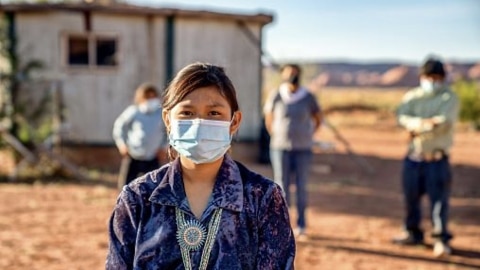
No running water or electricity? Sound like a third world country? No, it’s a fact of life for many on the Navajo reservation (about 37 percent of the Navajo Nation residents). This means the impact of COVID was so much worse for these residents than for many others across the country. The Navajo renamed COVID as Dikos Ntsaagii (“big cough”) (sorry I couldn’t type in the accents on the letters as they should be in Dine). As of October, 2022, the number of Covid cases in the Navajo Nation was 74,604 with approximately 1,919 confirmed deaths. However, the impact of the pandemic on health was only one of its many impacts for the Navajo Nation.
First, understand that the Navajo Nation is spread across the four corners region of the southwest (Arizona, New Mexico, Utah, and Colorado with tribal presence in Arizona, New Mexico, and Utah). The Navajo Nation is the largest Indian reservation in the United States. It comprises about 27,000 square miles, and it is inhabited by over 175,000 residents. To put it in perspective, this is about the size of the state of West Virginia. Approximately 40 percent of the residents are unemployed and live below the poverty line. About one third of the population suffers from diabetes, heart conditions, and lung disease.
Then, understand that other factors impact this population: Access to grocery stores is limited to about 13 grocery stores on the reservation, access to hospital facilities is limited to about 12 medical facilities with a total of 200 beds, access to electricity is nonexistent for about 15,000 people, as is the case with running water. Access to public facilities is limited by unpaved roads and no or very little public transportation. Also, when the population was told to shelter at home, that meant that their propensity to live in multigenerational households and in close proximity to one another, the spread of the virus was more inevitable.
With all of this as a background or context, it’s easier to understand why Covid also has had a very negative impact on education. For a large portion of the last couple years, students were not allowed to come to school; they were reliant on online education, or in many cases, cell phone access or packets of materials sent home via buses. When you consider the isolation of many of the homes on the Navajo reservation, access to broadband Internet is almost nonexistent or too expensive for many. As of 2020, the Internet service plans advertised in the Navajo Nation is $42.94 more expensive than the average promotional price for Internet service in the rest of the United States. With so many households below the poverty line, it was easy to see why they couldn’t afford Internet access, even if it were available. In several of the Navajo Nation schools that I have personally worked with, approximately 60 percent of students were without Internet access during the pandemic.
Schools tried a variety of methods to reach their students during the pandemic-created lockdown: sending packets of materials to students’ homes by buses (the usual way to also collect completed materials from students), calling students’ homes on what is usually one-cellphone access families, and sending laptops to students’ homes (if these were available or could be purchased by the schools). All of this was a meager attempt to keep students moving forward academically during this difficult time. Of course, Navajo students (as so many other Native American students) typically lag behind the majority of their American peers in major subjects. Only 37.8 percent of Native American students scored proficient on state standards-based assessments. Typically, the average student scores almost three grade levels below the national average in third grade.
This school year (2022-2023), the Navajo Nation schools struggle (as do many other schools across the country) with students who may be, for example, in third grade in school but are functioning at the kindergarten or first grade level. At least a third of the students in a third grade classroom cannot read at all. This makes it very difficult to prepare students for the typical standards-based assessment. In all grade levels, it’s a similar problem. Students who are typically already one or two grade levels behind can now be found to be as much as four grade levels behind, with major gaps in their learning depending on how much parents were able to help them as they were “home-schooled.” Schools are trying to help parents with working on academics with their children by providing some classes and support from parent liaisons who check in with the families regularly and offer ongoing training.
Currently, the broadband access to the Navajo Nation is being improved through a $50 million grant from the U.S. Department of Commerce to deploy high-speed Internet infrastructure. This money will be used to build 11 new telecommunications towers, 204 miles of fiber optics and other lines to provide high speed access to 27,000 homes. Of course, this does nothing for the over 30 percent of Navajo Nation homes that do not have electricity or running water. It also doesn’t solve the almost three-year lag in learning for Navajo students.
One thought for helping Navajo students who are struggling to “catch up” is to look at this issue as a need for “accelerating up” rather than “remediating down” problem. Schools and teachers would have to employ tools to diagnose exactly which skills students are missing that are prerequisites to moving forward. This technique would be especially important in reading because this is the basis for all types of learning. Standardized tests assess overall reading skills but do not provide data on the exact skills on which students need to work. That takes a different kind of diagnosis. Tools such as the SRA reading program (McGraw Hill program that develops comprehension, vocabulary, fluency, word analysis, and study skills) provide this kind of diagnostic assessment as well as materials to help students read at appropriately designated levels, based on their skill strengths and weaknesses in several reading areas.
It is not enough to just provide general tutoring (without an appropriate diagnostic assessment being administered first) or to just lump students into grade-level classes working on standards-based materials. If you don’t know which skills students are missing and start teaching students directly on those skills, you cannot easily have students progress in their learning of reading. Another more work intensive option would be to teach reading in a “nongraded” environment where students are grouped with other students at their skill level rather than in age-grade level classes. Even if schools could manage to do this for an hour or hour and a half per day, I think great progress for students reading and learning to read could be obtained.
No matter which approach is taken, students need to be assessed for specific skillsets so that they can be taught the major weak spots. If schools just continue to teach broadly or without assessment that targets the specific skill areas, little to no progress will be made. It is extremely important to start where the student’s needs are and teach those skills directly. Just “remediating” in the broad sense is not enough. Many skills need to be brought up to grade level in an accelerated way so that students do not lose any more learning time than they already have. This applies to all students, not just Navajo students, but since the Navajo students have so much stacked against them, it is crucial to meet them where they are and move forward as quickly as possible.
According to Dr. David Smith, Principal, Nenahnezad Community School, Fruitland, New Mexico “In addition to the remediation needed for all the students that have missed the important instructional in-person contact, we must also be sensitive to the social emotional needs of the child. An added problem during the pandemic has been family loss, grieving and anxiety for students. It is important to provide the students proper guidance and counseling tools to process these emotions and develop strategies to cope. The social emotional support of students is necessary to assist them to keep focused on the learning. We provide tutoring one-on-one in our 21st Century program and guidance an extra 30 minutes per week.”
Virginia Jumbo, Principal, Crownpoint Community School, Crownpoint, New Mexico summed it up this way, “In the process we learned and grew from the unprecedented experience, more resilient without losing our focus on students and their future.”
Sources:
- “Narrowing the Digital Divide in the Navajo Nation,” January 07, 2014, by NTIA
- “Historical Marginalization Had Left the Navajo Nation Uniquely Vulnerable to COVID-19,” Friday, May 22, 2020, Prosperity Now
- “Dine Navajo Resilience to the COVID-19 Pandemic,” August 4, 2022, https://doi.org/10.1371/journal.pone.0272089
- “The Cost of Connectivity in the Navajo Nation,” by Claire Park, October 12, 2020
- “Navajo Nation Awarded More Than $50 million for high-speed internet,” by Michael Marizco, August 31, 2022 from Fronteras
- “COVID 19: Internet Access and the Impact on Tribal Communities in New Mexico,” by Gavriel R. Sanchez, Carmela Roybal, Aakrit Joshi, by State of New Mexico Indian Affairs Department, New Mexico Native American Budget and Policy Institute, and New Mexico Center for Social Policy)
- Dr. David Smith, Principal, Nenahnezad Community School, Fruitland, New Mexico
- Ms. Virginia Jumbo, Principal, Crownpoint Community School, Crownpoint, New Mexico
About the author
Welda Simousek is the owner of an educational consulting company, Welda Consults, through which she has been working to train teachers, administrators, and parents in the Navajo Nation for the past six years. Welda Consults provides training in differentiating instruction, social emotional learning, classroom management, and best practices in teaching reading and math. Consulting sessions are tailored to meet the individual school’s needs. More information can be found on www.weldaconsults.com or by reaching out to Welda directly at welda@me.com


