The $250 Difference Between a Drop-Out and a Student

By Liz Texeira
Last month, I visited students in Kibera, Africa’s largest slum, who live in a 1.3 square mile area packed with startling poverty, regular violence, and some say over a million other people. But these girls are in school, with plans to become an engineer, a teacher, a neurosurgeon. In Mozambique, I met boys and girls who were sometimes the only ones in their family who got to eat every day, because they were fortunate enough to have a scholarship to attend schools that also provide meals.
For every young person I met in school, I know there were dozens just like them laboring at home or around the village, put to work because it costs their families too much to keep them in school.
In many developing countries, students are still required to pay school fees to attend school. These fees range from about $250 a year to upwards of $500. But for families living on a few dollars a day, it’s hardly a choice. Education might be available right down the road, it might promise incomparable opportunity—an average lifetime wage increase of 15-25 percent for each additional year of secondary school—young women who will grow into adults with healthier children and smaller families. But $250 might as well be a million dollars to a family that can’t afford it. In Mozambique I met family members who begged me for more corn so they could feed their other children who weren’t lucky enough to have a scholarship to go to school.
The disparity is heartbreaking, and it’s one that is becoming increasingly familiar to families in developing countries.
Thanks to the UN’s Millennium Development Goals, school fees for primary school in most of these countries have been abolished. It was a beautiful idea and a successful project, with a heap of unintended consequences: there weren’t enough books to go around and classrooms overflowed as students wildly outnumbered teachers.
Still, these hopeful young children went to school, but then as they graduated to the secondary level these same kids still end up dropping out even though they desperately crave an education. It just happens later now, when they hit the bottle neck at the secondary level created by school fees.
School fees are among the major reasons why 63 million adolescents globally are out of school.
So what’s so different about the students I was visiting in Kenya and Mozambique? They had scholarships.
I work at The School Fund, a nonprofit that crowdfunds scholarships for high-achieving but low-income students in developing countries. These students often test among the top in their primary classes but come dangerously close to having to drop out. Some do leave school, but thanks to the work of our field partners and the generosity of donors building scholarships $10, $20, $50 at a time, they return to school.
We take this work seriously because we understand the tremendous difference a scholarship can make in the life of one of these young people. One-hundred percent of contributions to students on our website go directly to that student’s scholarship. Operations for The School Fund are covered by grants and voluntary “tips” some donors make. Once funds are posted to a student’s school or community partner, the receipt is posted online with that student’s profile so funders can see for themselves that the school fees have been paid.
 Sometimes it’s overwhelming, considering the millions of students we can’t reach. Frankly, sometimes it breaks my heart knowing how many other young men and women are desperate to get back to school, but could only get there if someone with means believed in them enough to pay their way. And that’s why I get up every morning and try to grow The School Fund. We are a crowdfunder. We rely on a crowd. We need more people to know about school fees so they can understand our students, students for whom fees are a life-changing road block.
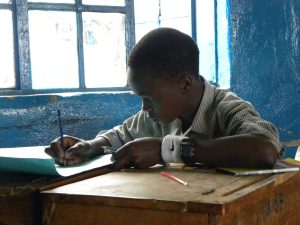
A Kenyan boy back to school thanks to a scholarship
I get behind my computer every day, whether I am in the field or at home, hoping to find ways to see more than a sea of kids from far-away countries. There’s Veronica, who is from a Maasi village in Tanzania and who now goes to a co-ed school which is in the top 10% nationally, and where she is a student-athlete and is excelling in science. There’s Dolly from Bhatpur, India, whose family pulled her from school because they worried about her traveling so far, but our partner Milaan helped convince her family to let Dolly go back in school with a TSF scholarship.
I care so deeply about this work because I know that too often $250 can mean the difference between a bright young person pursuing his or her dreams by staying in school… and dropping out. I see how a scholarship can lead a young girl in a slum to believe—and prepare to become—a scientist, a doctor, a teacher. I see how education grants young people the ability to expect more for their futures.
That $250, or even $500 is such a small investment for many of us, but is an investment that literally changes lives. Education is the key to a better life, and our students know that more than most.
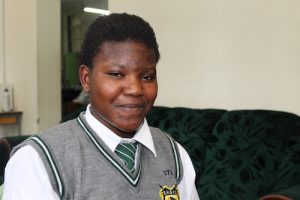
Mary Brenda, a SHOFCO student
About: Liz Texeira has spent her professional life working in education domestically and abroad, and went to Harvard, on scholarship, for undergrad and also graduated with a Master’s Degree in International Education Policy. She founded her own company, Girls Thinking Global, in the girls’ empowerment space; is a Teach for America alum; and has worked as an Emergency Medical Technician and Education Specialist throughout Northern Africa and the Middle East. At The School Fund, Liz works to engage diverse audiences, donors, and partners to increase awareness of school fees and help those groups join forces to create scholarships for high-achieving but low-income students in the developing world.