3D Printing Safety 101: How schools can safely use 3D printers in the classroom

By Dr. Marilyn Black
3D printers have become a valuable tool in K-12 classrooms because they inspire creativity and problem-solving by bringing students’ ideas and designs to life. 3D printers engage students, provide new learning opportunities and even strengthen their skills for one day entering the workforce.
However, this technology, which has become more affordable in recent years, also poses a health concern because of its potential to release volatile organic chemicals (VOCs) and ultrafine particles (UFPs) into the air during operation. This can affect indoor air quality and expose people to pollutants that may lead to adverse acute and chronic health concerns.
Therefore, educators should be aware of the risks associated with 3D printers and how to best mitigate them, particularly because growing K-12 students could be more prone to their potentially harmful effects.
3D Printer Usage Surges, So Should Safety
A Statista study shows that 3D printer use in education tripled in two years. It’s no wonder, since 3D printing provides a hands-on experience that helps students become creative inventors and solve problems in unique ways. Students can print anything from dinosaur fossil replicas to mini space rovers to topographical maps. In fact, close to half of schools in the United States house at least one 3D printer.
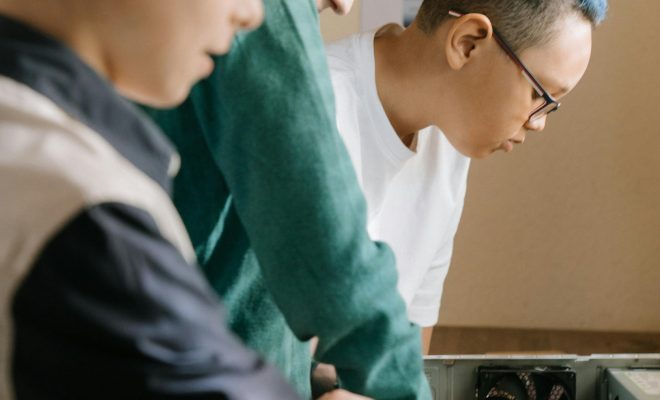
Teachers and school administrators should be aware, however, of findings from a comprehensive two-year study focused on understanding and characterizing the emissions from 3D printing and their potential health impacts. Chemical Insights – an Institute of Underwriters Laboratories – and Georgia Institute of Technology found that many desktop 3D printers, while in operation, generate UFPs and VOCs that may pose health concerns. UFPs can be inhaled and penetrate deep into the human pulmonary system, triggering lung irritation, respiratory and chest discomfort, and asthma. VOC exposure can result in headaches, eye and nose irritation, and flu-like symptoms. This is especially true when 3D printers are used in small or poorly ventilated rooms – such as windowless classrooms. Although students often want to be up close and personal when the machines are in operation, they should not stand near or hover over the printers.
Measures That Matter
Of course, that’s not to say that schools should avoid using 3D printers. But K-12 administrators and teachers should minimize exposure of emissions to students who are among the most sensitive to environmental exposure. This can be done by adopting these strategies when using 3D printers in the classroom:
- Ensure they are used in well-ventilated areas, have local exhaust fans or are operated under a fume hood;
- Keep students from standing beside or hovering over a printer while it is in operation;
- Set the printer nozzle temperature to the lower end of the suggested temperature range;
- Use filaments that are specifically recommended by the manufacturer for the printer; and
- Only use printers and filaments that have been tested and verified to have low chemical and particle emissions.
So, how would schools know what printers and filaments have been tested and verified to have low emissions?
Following their research, Chemical Insights worked with a range of stakeholders to create a national standard for testing and assessing particle and chemical emissions from 3D Printers. The Standard, ANSI/CAN/UL 2904, contains measurement and assessment protocols for UFPs and VOCs that can be emitted from 3D printers, print media and print applications. It applies to the types of 3D printers that are usually found in schools, homes, offices, libraries and other non-industrial indoor spaces.
The Standard allows manufacturers and laboratories to test 3D printers for their emissions and model their impact on the indoor air. If they meet the stringent standard criteria for low emissions, a printer can be verified or certified by a third-party program like GREENGUARD or Germany’s Blue Angel Program.
Think Ahead and Spark Excitement
Keeping students engaged can be an ongoing challenge for educators, and 3D printers are a great way to get them involved and excited about learning as they promote participation and encourage creative thinking.
Just be sure they are used in well-ventilated areas and that students aren’t too close to the 3D printer that’s in use. A printer’s nozzle temperature should be set on the lower end of the range. And lastly, when looking to invest in a 3D printer for the classroom, make sure to use devices and filaments deemed safe by ANSI/CAN/UL 2904, A Standard Method for Testing and Assessing Particle and Chemical Emissions from 3D Printers. Doing so will help ensure educators can still use 3D printers – but with safety top of mind.
About the author
Dr. Marilyn Black is vice president and senior technical advisor for Underwriters Laboratories, leading its research institute Chemical Insights. She is the founder and former chairperson for both UL Air Quality Sciences and the GREENGUARD Environmental Institute. She is also the founder of the Khaos Foundation, a non-profit organization dedicated to protecting the health and well-being of children through education and research. Dr. Black is an active participant in national and international scientific organizational initiatives, research projects and community outreach programs, and has presented and published over 200 papers on indoor air quality and environmental exposure. She received a Ph.D. from the Georgia Institute of Technology, M.S. from the University of Florida and B.S. from the University of Virginia.
This article was originally published by The Learning Counsel, a research institute and news media hub focused on providing context for the shift in education to digital curriculum.