KinderLab Robotics Announces KIBO Resources and Curriculum to Support Blended and Distance Learning for Early Childhood
In this time of educational disruption, KinderLab’s solutions help educators continue their STEAM programs and meet computer science standards through creative coding, arts, and imaginative play
(Waltham, MA) June 2, 2020 – KinderLab Robotics today announced the availability of resources and curriculum to support blended and distance learning using KIBO, the hands-on, screen-free STEAM robotics kit. Even during school closures in the face of the COVID-19 pandemic, schools can use KIBO to support age-appropriate STEAM learning and family engagement.
KinderLab’s new curriculum bundle enables teachers to incorporate KIBO into a distance- or blended-learning model for creative STEAM education both at home and at school. The bundle is supported by professional development that explains how to teach remotely with KIBO, as well as how to support parents using KIBO at home.
Jason Innes, the manager of training and curriculum development at KinderLab Robotics, Inc., said, “As we respond to changes to the structure of school, we need to hold onto what we know works in early childhood education. Hands-on manipulatives, playful learning, and student collaboration all remain vitally important. By providing students with access to KIBO during school closures and remote learning, schools can teach in a developmentally appropriate way while promoting connection between students, parents, peers, and schools. KIBO, along with curriculum and professional development from KinderLab, is a powerful foundation for early childhood remote learning.”
KinderLab has created a range of resources to help schools and districts incorporate the benefits of hands-on, screen-free robotics and respond to the uncertainty of how school will look in the fall. These include:
- A new whitepaper called Connecting with KIBO, which outlines the benefits of providing access to robotics for young children and models for how to teach screen-free computer science and coding despite school closures. The whitepaper includes sample lessons and suggestions for using KIBO regardless of the setting: remote learning by videoconference, blended learning in reduced-occupancy classrooms, and parent-facilitated learning at home.
- A webinar on June 3rd called How Can I Use KIBO in Blended or Distance Learning? Attendees will hear from two leading STEM educators from Boston Public Schools and The Agnes Irwin School on their practical suggestions and concrete advice for incorporating KIBO into a distance- or blended-learning model.
- For schools considering implementation of a home-based KIBO rotation program, KinderLab has created a convenient package of curriculum and professional development. The KIBO Blended Learning Curriculum Bundle, priced at $499, supports five KIBOs when rotating between students. This collection of teaching materials supports teacher-led, child-directed, and parent-supported playful learning. One hour of live video training is included, giving teachers the preparation they need to implement this model.
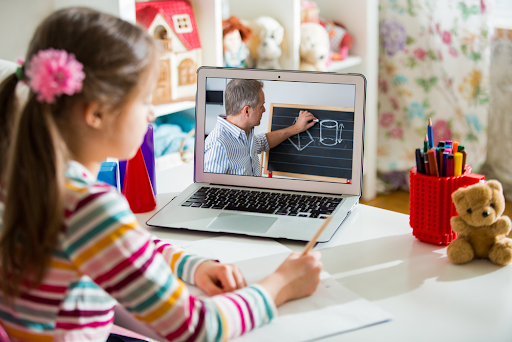
In early childhood, engagement with physical materials remains essential. With the school closures caused by COVID-19, teachers and parents around the country have seen that long videoconferences or purely screen-based lessons are not developmentally appropriate for young children. KIBO is a robot kit specifically designed for early childhood, so children program their robots with “tangible code” made of wooden blocks. Because KIBO is entirely screen-free, they engage in learning STEAM concepts through physical play and creative self-expression.
A distance learning program with KIBO can also be based on recorded lessons and demonstrations by the teacher, with children engaging in movement activities and unplugged coding games. KIBO’s standards-aligned curriculum can be adapted to work while students are at home using video lessons prerecorded by teachers, interactive videoconferences with teachers and peers, and parent-supervised home projects. Some lessons can be done without the physical robot, but the richest learning comes from hands-on engagement with KIBO, using robot kits made available for use at home. Supported by their parents and caregivers, children can play, imagine, and create, then share their creations with their peers to maintain engagement and connection.
“Many students lack reliable access to internet or computing resources at home,” Innes concluded. “Providing these families with access to KIBO is an important move toward equity in learning across our community. We think of KIBO as ‘1:1 for Pre-K–2,’ putting age-appropriate learning technology into students’ hands to be used with teacher support and parent engagement. By encouraging parents to take on the role of co-learner, we help address parents’ anxiety as well as promote deeper bonds—between parents and students, and between parents and schools.”
About KIBO – The Playful STEAM Robot
KIBO is a hands-on, playful robot kit that allows young children aged 4–7 to build, program, decorate, and bring their own robot to life without requiring a smartphone, tablet, or computer. It is an open platform on which students can envision and create their own robot. With art and engineering, students transform KIBO into imagined animals, vehicles, storybook characters, and more. Students plan a coding sequence using wooden programming blocks, then scan their sequence with the built-in barcode scanner, press its button—and the robot comes alive.
When children build, code, and decorate their own robot, they perceive it as play, but they are learning invaluable STEAM skills. Not only are these hands-on experiences inherently rewarding, but they help children understand the technology in their world and can even improve their future job prospects.
About KinderLab Robotics
KinderLab Robotics is the creator of the award-winning KIBO, a playful educational STEAM robot kit based on 20 years of child development research with thousands of children, teachers, and parents. Developed specifically for teachers by Dr. Marina Umaschi Bers at Tufts University, KIBO is currently used in 60+ countries and has proven efficacy in helping kids learn STEAM—and getting them excited about it! KinderLab offers a complete suite of teaching materials that help integrate STEAM elements into a wide range of curricula, including art, cultural studies, and reading literacy.
For more information, please visit KinderLabRobotics.com.
Press Contact
Chris Piehler
PR with Panache!