
The Passion to Ignite – Being a STEM Informal Educator

By Dr. Angela Gibson, Professor, School of Arts and Humanities at American Public University
Times Square Photo Credit: Jason Major (@JPMajor)
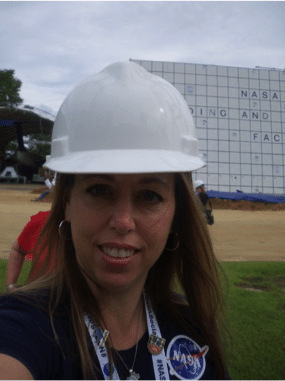
I am a mom, wife, professor of education, gardener, lover of 80s dance music, and a dog mom. I am also an informal STEM educator. When I say that to people, they look confused. Most aren’t quite sure what I mean.
STEM is an acronym for Science, Technology, Engineering, and Mathematics and is often used as a shorthand reference to STEM education. An informal educator develops educational content or provides educational instruction in a non-traditional setting such as a camp, museum, or homeschool or through volunteerism.
Though I am a formal educator serving as a professor at American Public University, my academic degrees are not STEM-focused. I enjoy working with students to promote their success in their first year of college and to provide guidance to students who are considering a career in education. However, I have always had a passion for STEM fields, particularly science. Probably somewhere in a parallel universe I am an NOAA meteorologist or a planetary scientist assigned to a really cool NASA mission.
So why add on the role of informal STEM educator? Passion. Curiosity. Sharing. Helping others. Watching the light bulb glow above a child’s head! The rewards are endless. I have taken my natural interests in certain fields, done some additional investigating and professional development, and utilized curriculum design and presentation skills to create programs for kids. My willingness to be silly, dress-up like a butterfly, and be a kid myself doesn’t hurt either!
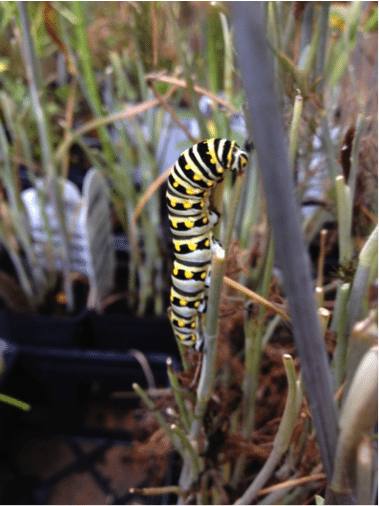 My young son and I create butterfly gardens in our backyard. Through reading books, talking with master gardeners, attending workshops and scientific testing, we have a good grasp on certain concepts and natural occurrences. That effort led me to create a hands-on presentation of the caterpillar lifecycle for young students. I bring in live swallowtail caterpillars for the presentations. From our own stock of items saved through the last several years, I have butterfly wings and pupa kids can touch, video of caterpillars transforming into chrysalises and then emerging as butterflies, and live examples of nectar and host plants. As part of the program, I help children to plant the seeds of nectar plants in small take home pots. And, yes, I also dress up in butterfly wings and antennae and flit around the room!
Another area of personal interest that I share in informal educational opportunities is space. Fostering my son’s and my own curiosity about everything related to space and space exploration has allowed me to be selected for NASA Socials. A NASA Social is an opportunity for those with social media accounts to be selected for “behind-the-scenes at NASA facilities and events and speak with scientists, engineers, astronauts and managers.” Events are typically focused on a particular activity – such as the building of the James Webb Telescope at NASA Goddard in Maryland or the landing of the Curiosity Rover on Mars, which became a multi-center and worldwide event – or can involve a focus on a subject area – such as aircraft alternative fuel testing and aeronautics or the study of missions for Earth science.
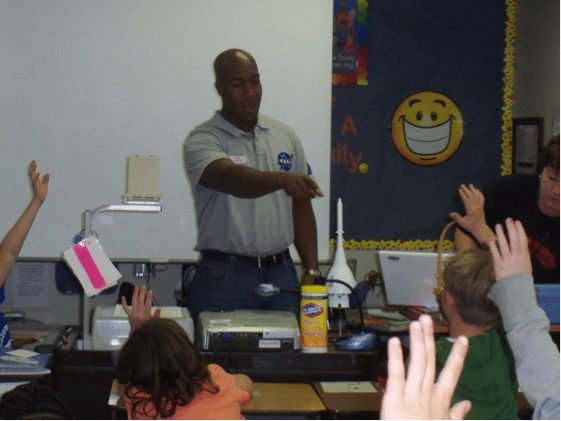
Through one NASA Social, I made connections with a local NASA Program Manager for the Orion Spacecraft, who then offered to visit a school and discuss NASA’s newest spacecraft and mission for space exploration with the children. Another connection developed in learning about a particular mission of training astronauts underwater provided an excellent opportunity for a camp of fourth through eighth graders to Skype live with Aquarius Reef Base, the world’s only underwater laboratory.
When a local preschool wanted to learn about the planets, I used straws, candy bars, single ice cream and sorbet cups, and some planetary pictures to let the kids try a hand at taking core samples on the rocky planets, the gas planets, and the ice planets of our solar system.
 Do you have a STEM-related passion? You can be an informal educator, too. Find a subject of interest, stay current on the topic, assess your own expertise and abilities, and develop a program for a target audience. Then, look for good venues to share your knowledge.
As an informal educator, I pursue my own passions and interests and share with others, and I continue to learn about topics that interest me while engaging young minds. The reward is in seeing the sparks of imagination and curiosity fly.
About the Author
Dr. Angela Gibson is a Professor for the School of Arts and Humanities at American Public University System. She has previously worked at community colleges, private institutions of higher education, and state universities teaching face-to-face, blended, and fully online courses teaching first-year as well as Master’s and Doctoral students. When not attending a NASA Social or providing STEM educational outreach, Dr. Gibson serves as a facilitator and mentor for the Online Learning Consortium, publishes, and presents at national and international education conferences. She received a B.A. in International Relations from George Mason University, a Masters of Arts in Human Performance Systems, with a Graduate Certificate in Instructional Design, from Marymount University, and an Ed.D. in Educational Leadership, with concentrations in Adult Education, Higher Education, and Community College Education, from Texas A & M University – Kingsville. Find me on Twitter at @AgilistaAG.


