A Back-to-School Checklist: Choosing Classroom Technology that Fosters Engagement

Op-Ed, By: Dr. Charles Miller, Professor at University of Minnesota, Cofounder/ Chief Design Officer of Vidku and Cofounder of Flipgrid
A new school year has begun and educators will face the task of engaging a new set of students. Cultivating an environment where students are consistently engaged with the curriculum brings a unique set of challenges with each new mix of students and level of study.
Since each student comes with a myriad of individual skills and learning styles, it can be tough to create a learning environment that meets everyone’s needs. One student may be more stimulated through visual or audio learning, while another may need to actively interact with lessons through kinetic learning methods. Educators who have the resources to teach in a way that satisfies the variety of learners taking their classes are best equipped to help not just some, but all of their students to succeed.
Passive methods of instruction, such as a standard lecture or showing of a video, are effective in their ability to lay the groundwork for new course material. An active learning approach molds and further embeds newly introduced concepts into learners’ minds by providing them opportunities to engage more fully with course material. As shown in National Training Laboratories’ Learning Pyramid, learners’ retention rates jump from a maximum of 30 percent with passive teaching methods, to a minimum of 50 percent and up to 90 percent with participatory teaching methods.
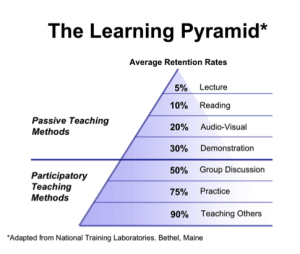 This makes a clear case for adding tools to your staff’s pedagogical arsenal that help foster participatory, or active, teaching methods.
Providing your educators with the tools they need to cultivate a collaborative and engaging learning environment is one way to help them inspire each and every student to be proactive learners and active participants in their learning process.
Interactive technologies can promote classroom collaboration, especially when they enable each student to share their ideas with the rest of the group.
Below is a checklist you can use as a guide for vetting education technology for its ability to promote active learning in your course offerings. Ask your edtech decision-makers these questions to determine whether a technology will help your educators effectively foster student engagement.
Does the technology…
- Develop critical thinking and problem-solving skills (does it promote challenge-based learning)?
- Fulfill a variety of personal learning styles to meet each student where they are?
- Bridge gaps in participation or student engagement to allow for peer-to-peer collaboration that empowers students to voice their diverse opinions on a subject?
- Foster exploration of a subject outside the walls of the classroom?
- Provide the instructor and learner with an intuitive interface to navigate from each end?
- Track the progress of student learning, achievement or engagement?
- Present the opportunity for students to give the educator feedback on the structure of the class or the progress of his/her own learning to-date?
When incorporated effectively, technology is a great way to increase engagement in and out of the classroom, sometimes with immediate results. Whether it be in a college lecture hall, a course taught online or in a blended learning elementary school classroom, providing learning experiences for your students that are built upon the principles of engagement and interaction will position your educators to jumpstart the new school year with powerful learning and discovery.