Cognitive Learning Strategies: Making Learning More Productive and Efficient

By Betsy Hill and Roger Stark
The term cognitive learning is used to characterize specific aspects or theories of learning and generally implies a view of learning that:
- Relates to conscious understanding rather than behavioral knowledge (skills). These two different types of learning are also referred to as declarative knowledge and procedural knowledge. Declarative knowledge refers to knowledge that can be stated and includes things like what you had for dinner last night, the date of the first moon landing, and the history of the Civil War. Procedural knowledge refers to skills that have been acquired through repetition and includes things like playing a piano piece, driving a car and decoding words.
- Explains the process of learning in terms of prior knowledge, where new information has to be connected with and integrated into existing knowledge. Existing knowledge is sometimes referred to a schemata or structures of understanding that model how the world around us works. From a neuroscience perspective, knowledge is encoded in the connections of neurons into neural networks and new information is connected into existing networks in order to be learned and understood.
- Recognizes that cognitive processes (cognitive functions or skills) in the brain are how declarative knowledge or cognitive learning is acquired. Many discussions of cognitive learning theory address attention, sensory memory, working memory and long-term memory and the role of these cognitive skills in learning.
- Characterizes the operation of those cognitive processes on experiences the individual has and the ability of teachers (including teaching oneself) to modify the learning experience to improve the quantity, quality, depth and durability of learning.
Cognitive learning theory makes the case that we can use what we know about the cognitive processes needed for learning and research on effective learning strategies to make learning more productive and efficient. In this context, what learners and teachers need to understand then, are the cognitive skills involved in learning, both generally and for that individual learner, and the types of learning experiences that are most effective in getting information through those cognitive processes, stored in long-term memory and available for use in practice.
Cognitive Skills and Learning
Cognitive skills are the mental processes our brains use to take in, understand, organize, store, retrieve and use information. They include a variety of attention skills, visual processing, auditory processing, sensory integration, memory, executive functions and reasoning. Cognitive skills are the foundation of learning and account for an estimated 42 percent of the variance in academic performance.
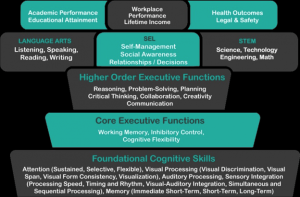
For a basic understanding of cognitive skills, we recommend https://mybrainware.com/cognitive-skills/ and https://mybrainware.com/what-is-learning/.
The next thing we need to understand about cognitive skills is that every individual has cognitive strengths and weaknesses, and this is what accounts for, to an under-appreciated degree, the dramatic variability of students’ ability to learn different types of information.
Cognitive learning requires that teachers understand their students’ cognitive profiles and that students understand their own cognitive strengths and weaknesses. It requires both teachers and students to develop the ability to practice the learning strategies that are best suited to individual learning capacity. This can be accomplished with a short, affordable cognitive assessment like Mindprint, resulting in a student profile like the following:
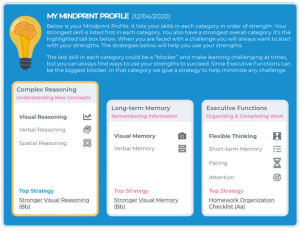
In the profile above, this student’s strengths are her reasoning skills, especially visual or abstract reasoning. Therefore, the top strategy in this area will help her use that stronger reasoning ability to understand what she is trying to learn and to solve problems (apply concepts). This student has stronger visual memory (memory for images, charts, graphs) than verbal memory (memory for language-based information). Knowing this, the student will focus efforts to acquire new vocabulary on pictures and images, rather than simply learning a definition. And finally, this student’s executive functions, particularly working memory, processing speed and attention, are likely to be a stumbling block in demonstrating her learning and the suggested strategy will help her stay on track by organizing her approach to homework.
Boosting Cognitive Skills
In addition to adopting best-fit strategies according to a student’s learning profile, teachers and students also need to understand that cognitive skills can be developed. Whatever cognitive strengths and weaknesses we have, we can improve our capacity to learn by strengthening our cognitive skills.
Designing the Learning Experience
Since each brain must process new information for itself, the role of the instructor (whether a teacher, a trainer, or an individual learning on his or her own), is to facilitate a learning experience that will result in efficient and effective learning for a variety of different individual brains. This is why cognitive learning focuses on the interaction of the student with the information/experience. Interacting with material in meaningful ways and in a variety of ways will help connect it to existing neural networks (or schemata) in stronger and more durable ways. Our brains did not evolve to learn meaningless information, so learning experiences need to emphasize enabling students to build meaning. This can be accomplished with activities that involve elaboration, rather than rote memorization (recall that cognitive learning focuses on declarative knowledge, not procedural knowledge where rote practice is, in fact, applicable).
Elaborative learning strategies could include activities such as:
- Reciprocal or peer teaching
- Metaphor and analogy
- Mnemonics
- Models
- Story-telling
- Role-playing
- Problem-based learning (or project-based learning)
- Developing visuals and graphics
- Simulations
- Hands-on activities
- Rhythm, rhyme and rap
- Mind maps (semantic maps)
- Reflect and write (journaling)
Metacognition
While the term meta-cognition does not always appear in discussions of cognitive learning, it does capture the essence of the approach. Cognitive learning requires meta-cognition or thinking about one’s thinking and one’s progress in the learning process. It requires understanding one’s cognitive skills and how to best use them in learning experiences and it requires an understanding of the learning process itself to make it deeper and more meaningful.
One definition of metacognition that captures this sense is provided by the TEAL Center —The Teaching Excellence in Adult Literacy Center, a project of the U.S. Department of Education, Office of Career, Technical, and Adult Education (OCTAE).
“Metacognition is one’s ability to use prior knowledge to plan a strategy for approaching a learning task, take necessary steps to problem solve, reflect on and evaluate results, and modify one’s approach as needed. It helps learners choose the right cognitive tool for the task and plays a critical role in successful learning.”
This implies, like the discussion of cognitive learning above, the need to take into account individual learner variables, the characteristics of the learning task, and the strategies one employs to facilitate the learner’s experience.
About the Authors
Betsy Hill is President of BrainWare Learning Company, a company that builds learning capacity through the practical application of neuroscience. She is an experienced educator and has studied the connection between neuroscience and education with Dr. Patricia Wolfe (author of Brain Matters) and other experts.
She is a former chair of the board of trustees at Chicago State University and teaches strategic thinking in the MBA program at Lake Forest Graduate School of Management. She holds a Master of Arts in Teaching and an MBA from Northwestern University.
Roger Stark is Co-founder and CEO of BrainWare Learning Company. For the last decade, Stark championed the effort to bring comprehensive cognitive literacy skills training and cognitive assessment within reach of everyone. It started with a very basic question: What do we know about the brain?
From that initial question, he pioneered the effort to build an effective and affordable cognitive literacy skills training tool based on over 50 years of trial & error clinical collaboration. Stark also led the team that developed BrainWare SAFARI, which has become the most researched comprehensive integrated cognitive literacy training tool delivered online in the world. Follow BrainWare Learning on Twitter @BrainWareSafari
This article was originally published by The Learning Counsel, a research institute and news media hub focused on providing context for the shift in education to digital curriculum.