
Professional Development and Teacher Evaluations: A Fragmented Problem of Practice

By Dr. Jose Rodriguez
Assistant Dean, School of Education at American Public University
 I spent 25 years in the field of education in various districts across Texas and Washington. In those years, my roles included para-educator, teacher, curriculum developer, and school administrator. The years in education motivated me to concentrate on the teacher evaluation process.
Thirteen of those years were spent teaching in the classroom. For me then, the teacher evaluation process was a procedural requirement that had to be performed by school administrators. It did not impact my teaching because the observation process had no connection or relevance to what I was doing in the classroom. I recall my colleagues talking about the evaluation process as a chore that was not meaningful to their teaching.
My different roles in the field of education have given me the opportunity to look at the teacher evaluation process through different perspectives and experiences.
Problem of Practice
Staff development matters! As teachers and school administrators begin to look at starting the next school year, staff development is very much part of the agenda. Staff development comes in many different forms and is offered at schools to the entire staff, in departments, groups, and individually.
Too often, staff development is not a targeted to the needs of particular teachers. With veteran teachers leaving districts and new teachers taking over the helm, staff development needs to be well defined and more targeted in order to bring young teachers up to speed quicker. This becomes a systems level issue at both the school and district levels.
Teachers often seek professional development on their own and many times spend their own time and money outside of work seeking these learning opportunities. They often select computer training, software for grading, Smartboard training, and teaching strategies. These offerings may not be directly related to the teacher assignment or to the direct needs of the teacher. Where is the administrator leadership in guiding professional development?
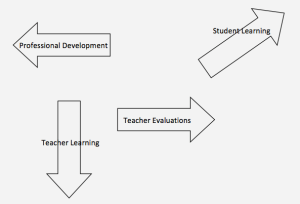
Without question, administrators at the school and district levels in charge of professional development and teacher evaluations have a primary impact on teacher learning. The leadership challenge in the line of work exists in that no adequate system is in place to access real-time teacher observation data.
The Answer Is in Technology

Technology can bring coherence to teacher evaluations and professional development, two of the most important duties district and school administrators perform in order to increase and sustain student achievement. A leadership dashboard can provide a systems approach to sustain real-time organizational learning and targeted leadership action.

Using the teacher evaluative criteria in formative observations links two necessary components in linking professional development to teacher evaluations. The evaluative criteria provide schools and districts with the opportunity to identify areas where professional development might be needed. Using teacher evaluations to guide professional development can mean more targeted decision making at the systems level on the needs of teachers.
Targeted action can lead to better teacher knowledge and preparation to foster a more conducive student learning environment. Teacher evaluation dashboards can build capacity through aggregating organizational history and learning and connecting learning to organizational needs.
About the Author
Jose A. Rodriguez, Ed.D. is currently Assistant Dean for the School of Education and Program Director for the Educational Leadership Program with the American Public University. He received a B.A. in Political Science and History, with teacher certification, with the University of Texas-Pan American—Edinburg; a master’s degree in Political Science and Sociology with Texas State University—San Marcos; and a Doctor of Education in Educational Leadership and Policy Studies with the University of Washington—Seattle. Prior to academia, Dr. Rodriguez spent many years in public schools as teacher, writing curriculum as district curriculum developer and as school administrator.


