Rubrics: Protecting Our Learning

Guest Article Written By: Mac-Z Zurawski
As a professional learner I am always intrigued by methods that create pathways to greater learning. While in my online teaching certification process I revisited a great tool: rubrics. Yes, I had seen them before but not in this light. As a graduate student I reviewed them as a checklist for my assessments. I didn’t really believe they were much more than an extra set of instructions. That has all changed. Now that I am creating my own rubrics I believe they are a set of guiding lights to protect ourselves, our learners and the assessments we create.
We have all had students that haven’t completed or completely misjudged the instructions for an assignment. The excuses can range from your instructions were not clear to I couldn’t find the instructions for the assignment. Well, as a protection for ourselves we can attach rubrics to each assignment besides the instructions. These rubrics can be very detailed on the inclusion of points in a project to a general checklist. Either way a student won’t be able to say they didn’t know what was asked of them.
I ask my students to write a white paper on a current issue within the political sphere. My instructions are to cite at least one court case and two sources to support their opinion from our course materials; and must abide by the white paper guide and MLA guidelines in the papers formatting, citing and referencing. The paper can only be 1 page long with an introduction, supporting paragraphs and conclusion.
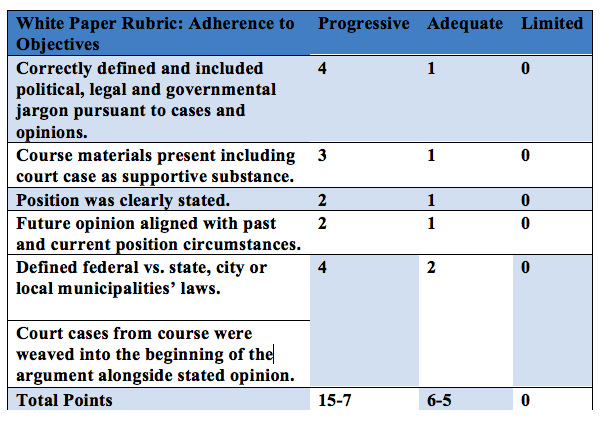
Rubric Example 1: White Paper Rubric
This rubric gives the students a more detailed set of instructions on what I’m looking for within the paper. If I didn’t use this rubric students would have many more questions and possibly complaints on the assessment. I have protected both of our interests.
Analytical vs. Holistic
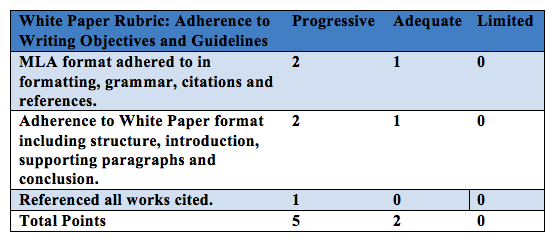
The type of rubric is up to the individual. Analytical rubrics are very detailed. They are based upon degrees of quality. An analytical rubric will be similar to the one pasted above. There will be more specific guidelines for the assignments and point differences. These rubrics can be as detailed as an instructor likes. Analytical rubrics can come in multiples as well. I include analytical rubrics for major assignments such as papers. I will present a rubric on the assignment and one on the adherence to good writing. I believe that major assignments need major detail and vice versa. The following rubric will be presented as a guide on writing.
Rubric Example 2: MLA Adherence Rubric
Holistic rubrics present very general instructions. They will not be detailed. The rubric will give simple criteria for an assignment such as handed in on time, participated, or even included name on paper. I use holistic rubrics for discussion and reflection assessments. I tend to use these for the formative assessments. I just want students to know that even though a reflection or discussion is worth low points I am still reviewing for some content within these “easy” assessments.
Rubric Example 3: Discussion Board Grading Rubric
As you can see there is nothing detailed or fancy. It’s a very simple tool to present to students as a guide. I also like these because it is a simple way for me to grade. I can use the quick point system to spend more time on feedback.

Easy Tool for All
A detailed rubric presents the tools and needs of an assignment in a clear manner. Rubrics are an easy tool to design. There are ample sources of rubrics throughout the web and on many teaching sites. Many universities have installed rubrics creators to enhance the ease of teacher’s usage. I create my own rubrics with the table maker on Microsoft Word. You can add all the details you want, change colors, split the tables, etc. This is a great tool for new teachers. As they are trying to decide who did well or what info they really want a rubric organizes thoughts. It helps me to separate my assessment needs. By the time I’m done with my rubric the entire assessment has been changed and flipped over a few times, but it’s perfect. Rubrics can even be a great starting point for an assessment. List what you are looking for first.The rest will follow.
Feedback
Lastly, rubrics are a great way to add immediate feedback for students. When the rubric is created add an extra blank column for feedback for students. If you have given an A add a quick comment as to why. If a student has struggled with a concept throw in a comment and a possible resource or reference for them. There is as much room as needed if you create your own rubric table.