The Science of Reading: 5 Steps to Literacy Success for All Students

By Dr. Ana Gabriela Bell Jimenez
I’m a native Costa Rican who moved to the United States as a foreign exchange student when I was 20. I know what it feels like to learn a second language—to be an English language learner (ELL), and to be biliterate. That’s why I focus my work on literacy for English language learners and other historically marginalized populations. When I started out as a high school English language arts teacher here two decades ago, I came to a realization that shapes what I do today. Despite the fact that I hold multiple licenses, passed all the interviews, completed my academic preparation, and could read and write in two languages, I didn’t know how to teach literacy in English. I didn’t have all of the tools I needed to help my students succeed. It was a vulnerable moment in my career, but one that helped me begin to engage in more meaningful, transformational practice. While there’s a huge body of research—referred to as “the science of reading”—that can guide educators on how to teach literacy effectively and improve outcomes, many educators aren’t aware of it, nor can they easily access it. In this article, I’ll share with you five steps you can take to improve literacy outcomes for your students, guided by the science of reading.
Steps to Literacy Success for All Students
Verbalize Your Vision
The first step in helping your students become skilled readers is to create and verbalize your vision. This means considering your background and experiences, and then naming your desired literacy outcome. While a vision for instruction can exist at a systems level, it’s important that we as educators verbalize our own vision and commitment to these academic outcomes because we have such a powerful impact on students. For example, at Madison Metropolitan School District, our vision is: ”Every school will be a thriving school that prepares every student to graduate, ready for college, career and community.” This is how we articulate our belief system. Based on this, I created my personal vision that every student, regardless of ethnicity, language or socioeconomic status, will graduate college and career ready.
Create Your Goal
Once you’ve articulated your vision, it’s time to define your goal. Break down your vision into specific questions and use data to find the answers. In my example, I needed to find out who my students are and the meaning of “ready for college, career, and community.” To find the answers, I turned to the data. Because 27 percent of our district is English language learners, I had to factor those students into my goals. I also needed to concentrate on African-American students and students with disabilities. Next, I had to define college and career ready. For me, it means that every single student has access to grade-level text. Finally, I attached metrics to that goal. I analyzed how many of these English language learners, African-American students, and students with disabilities were currently meeting my vision and goal, and backward-mapped to determine how much work I had left to do.
Align Instructional Practices with Research (The Science of Reading)
Now that you’ve created your goals, you’ll need to take a look at your practice to see how effective you’ve been with your instruction. At this point in my journey, I again looked at my data. I wanted to find out how my specific groups of students were performing. By conducting this analysis, I came to the conclusion that my instructional efforts were not translating into academic achievement. I needed to find out how my instructional practices lined up with the research to help me achieve my goals. That’s how I discovered the science of reading. According to Dr. Louisa Moats, the science of reading can be explained in the following way: “The body of work referred to as the ‘science of reading’ is not an ideology, a philosophy, a political agenda, a one-size-fits-all approach, a program of instruction, nor a specific component of instruction. It is the emerging consensus from many related disciplines, based on literally thousands of studies, supported by hundreds of millions of research dollars, conducted worldwide in many languages. These studies have revealed a great deal about how we learn to read, what goes wrong when students don’t learn, and what kind of instruction is most likely to work the best for the most students.”
Having a solid understanding of the science of reading is fundamental to adjusting and improving your pedagogical practice. This body of research can be more fully explained by looking at some key theoretical frameworks.
The Simple View of Reading
The Simple View of Reading (Gough & Tunmer 1986) states that reading comprehension incorporates two connected processes:
- Word recognition or decoding
- Language comprehension
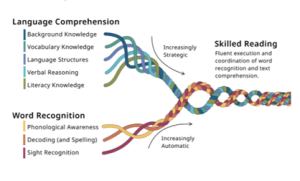
The framework states that you can’t achieve reading comprehension unless you can decode and comprehend text. But what does this really mean? The Reading Rope We can break down the components of The Simple View of Reading further by looking at the Reading Rope (Scarborough 2001).
This framework explains the elements that make up both language comprehension and word recognition. It states that language comprehension is made up of background knowledge, vocabulary, language structures, verbal reasoning, and literacy knowledge.
The other strand of the rope—word recognition— consists of phonological awareness, decoding, and sight recognition. Skilled reading is the result of mastering these two areas.
Download your free guide to read more and register to see Dr. Gabi Bell at the National Literacy Summit on November 9, 2021!
About the author
Dr. Ana Gabriela Bell Jiménez is the Director of Instruction for Literacy, Biliteracy, Arts, World Language, and Humanities at the Madison Metropolitan School District in Madison, Wisconsin. She is passionate about early reading for socially, culturally, and economically diverse students. Her research centers on the Science of Reading in multilinguistic instructional settings with adolescent learners. Some of her publications leveraging education and race are Facts and Challenges Facing Bilingual Intercultural Education and Interculturalism: A Case Study of Afro-Costa Ricans (2020) and Education as a vehicle for social transformation: Paulo Freire’s pedagogy (2017).