EdNews Daily

Top Menu

  • 2020 Tech Resources
  • About
  • Activity
  • Add Listing
  • Archive 3 Col Full Width
  • Archive 4 Col Full Width
  • Articles
  • Author
  • Bark-Free 7 Day Trial
  • Blog Classic Style
  • Blog List Style
  • blogging
  • Book: How I Changed My Career Path
  • Checkout
  • Checkout
  • Checkout Here
    • Purchase Confirmation
    • Purchase History
    • Transaction Failed
  • Confirm Subscription
  • Contact Us
  • Coupons for College Students
  • Deals
  • Directory
  • Disclosure
  • ED Tech Interviews
  • EdTech Company Sign-Up Page
  • Edtech Consulting
  • EdTech Consulting and Advising
  • EdTech Meetings: Book Appointment
  • Education Coupons
  • Education Freelance Jobs
  • Education Partnerships
  • Education Public Relations
  • Education TED Talks
  • Educators Sign Up
  • for me
  • Forum
  • Grants & Contests
  • Groups
  • Hire ESL Teachers
  • Home
  • Home Page
  • Home variation 3
  • Home variation 4
  • Home variation 5
  • Home variation 6
  • Home variation 7
  • Home variation 8
  • Homeschool Resources
  • Info
  • Job Board
  • Job Dashboard
  • Jobs
  • Jobs for Teachers
  • Latest Education News
  • Layout Columns
  • Layout Columns Full Width
  • Learning LinkedIn Community
  • LinkedIn Coach
  • LinkedIn For High School & College Students
  • LinkedIn For Teachers
  • Listing Preview
  • Listing Success
  • Location
  • Logging In
  • Login
  • Lost Password
  • Media Packages
  • Members
  • Monthly Contest
  • News
  • Our Partners
  • Pages
    • Full Width Page
  • PlayBuzz Fun Teacher Quizzes
  • Podcast
  • Policies and Reviews
  • Post a Job
  • Privacy Policy
  • Purchase Confirmation
  • Reaching Teachers: Partnership Inquiry
  • Recent Activity
  • Recent Activity
  • Recent Activity
  • Recent Activity
  • Recover Password
  • Register
  • Site Registration
  • Sitemap
  • Submit Site
  • Teach English Online
  • Teacher Book Entry Form
  • Teacher Profile Form
  • test
  • test
  • Test Forum
  • Upcoming Promotions
  • User Profile
  • What Grade Should You Teach?
  • World Teachers’ Day 2019
  • About Robyn
  • Redirect
  • Shortcodes
    • Icons
    • Typography
    • Pricing Tables
  • Alternatives to Teaching

Main Menu

  • Home Page
  • Digital Learning
  • ESL and Bilingual
  • How Learning Works
  • Innovation
  • Science
  • Technology
  • Learning Futures

logo

EdNews Daily

  • Home Page
  • Digital Learning
  • ESL and Bilingual
  • How Learning Works
  • Innovation
  • Science
  • Technology
  • Learning Futures
FeaturedHow Learning WorksTechnology
Home›Featured›What’s Working in Education

What’s Working in Education
By Charles Sosnik
March 29, 2022
2540
0

Do Something Awesome; Share With A Friend Who May Benefit

Share on LinkedInShare on FacebookShare on X (Twitter)Share on PinterestShare on Email

By Zach Vander Veen

Right now, across much of the world, parents are holed up with their children and performing the role of educator, or else they are playing the role of a Hybrid educator, filling in part time while students are home because of COVID surges or teacher shortages. In this continuing Covid-19 world, we’re all getting a crash course in teaching. Many parents are asking a familiar question to teachers.

Hey, does this work?

“This” being the way we’re teaching. Are my kids learning by reading a book? By filling out an online worksheet? By sitting in a Zoom class? By me hopelessly sketching out the “old” way of doing math on scratch paper? What is likely to increase my child’s achievement?

Sometimes we find ourselves asking a variation of the question. Is there a better way to do this?

Is it better for my daughter to watch a YouTube video on photosynthesis or help me plant seeds in the garden and listen to me explain sun-to-food in a different context? Both strategies help her learn. But if constrained with time and life (which, admittedly is a bit more open and slower at this moment), what makes the most sense?

Is there a way to know? And as a teacher, what should you be telling your parents?

Visible Learning

Fortunately, scientists and social scientists have focused their attention on what works with learning. Cognitive scientists examine the question from the perspective of how the brain works. Relatedly, social scientists study and explore how differing academic pedagogies affect academic outcomes. In short, we have a lot of studies.

Making sense of them is a bit of a challenge.

Which is where John Hattie comes in to help synthesize and model what works, based on research. Hattie does this by combining a variety of meta-analyses. A meta-analysis is a statistical analysis that takes multiple studies that address the same (or sometimes similar) question and attach a broader conclusion. Hattie published a study called “Visible Learning” that ranks the top 252 influences in academic outcomes. He does this by linking an effect size to each influence.

Effect Size

Effect size plays a critical role in determining what we should pay attention to when making choices in education. What is effect size?

In statistics, an effect size is a quantitative measure of the magnitude of a phenomenon. Effect size is an essential component when evaluating the strength of a statistical claim.

The larger the effect size number, the stronger the relationship between the variable of academic outcome and influence. In educational studies, we typically see effect sizes ranging from -.5 to +1.75. While there is debate on what the cutoffs should be when it comes to making a decision based on effect sizes, most folks consider an effect size of +.3 or below to mean small impact while anything above .7 to indicate a high level of impact. John Hattie uses .4 as the cutoff for desired outcomes in education.
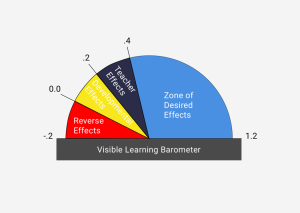
This is an essential concept. Nearly everything has an influence on a related variable when doing a study. Some argue the fact that we’re observing means we have an impact. Some things have more significant influence.

In short, everything works. Some things work better than others.

We all are finite resources. We can only do so much. Given that simple fact, what should we spend our time on when it comes to educating kids?

About the author

Zach Vander Veen has worn many hats in education, including history teacher, technology coach, administrator, and director of technology. He loves learning, teaching, traveling and seeking adventures with his family. Currently, Zach is the co-founder and VP of Development and Customer Success at Abre.io, an education management platform.

TagsVisible learningWhat's working in education
Previous Article

Podcast: Heritage Relevant Digital Learning Design

Next Article

Cognitive Approach to Addressing the Impact of ...

Related articles More from author

  • ESLFeaturedTechnology

    This Is What It’s Like To Teach Online And Meet Your Students In-Person

    July 31, 2017
    By Robyn Shulman
  • FeaturedHow Learning WorksTechnology

    Grading Your School? How do They Rate in the Science of Learning?

    April 17, 2023
    By Charles Sosnik
  • FeaturedTechnology

    Educating for the Design Economy

    December 6, 2019
    By Charles Sosnik
  • What are good ESL activities?
    Digital LearningEducation NewsESLFeaturedTechnology

    Theories & Activities for Second Language Acquisition

    April 24, 2024
    By Robyn Shulman
  • FeaturedpodcastTechnology

    Podcast: New Answers to Systemic Inequity of Language Learning

    October 1, 2021
    By Charles Sosnik
  • Education NewsFeaturedOp-Ed

    Understanding the Causes of Teenage Suicide

    July 8, 2019
    By LeiLani Cauthen
© Copyright 2011-2026, EdNews Daily. All rights reserved.